





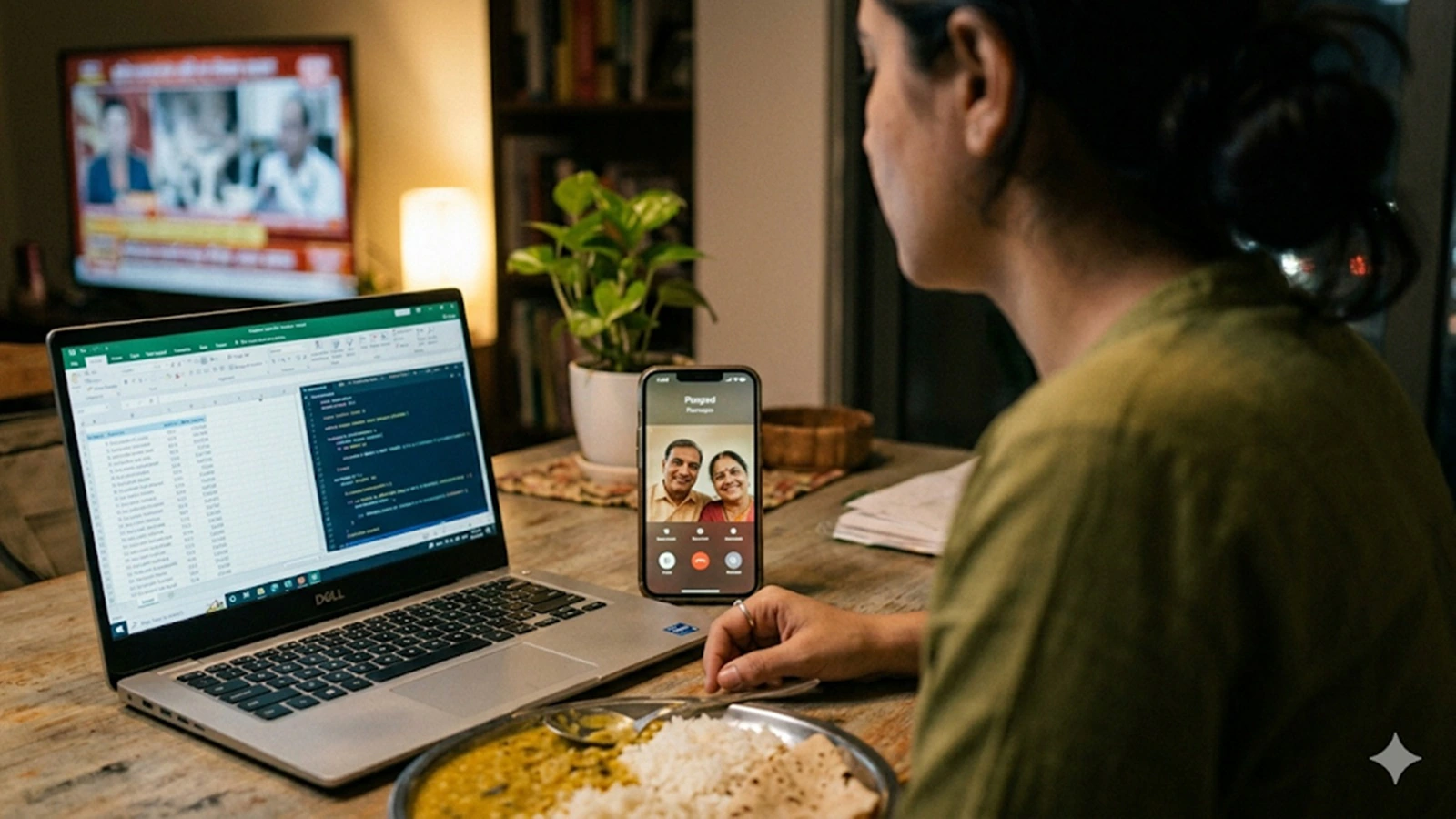
It has been over a decade now. I live in Delhi. My parents are in Odisha. In that entire time, I have never lived at home with them for longer than a month. And even those visits feel shorter each year, more compressed, more charged with the awareness of the return flight. What I have built here is real: a career, a life, a sense of self and independence. But there is a cost to that, and it took me years to be honest about what it was. It struck me when I visited my parents a few weeks ago.
The loneliness that doesn’t look like loneliness
Nobody tells you that loneliness in your late twenties isn’t obvious, but it settles in around the edges of a perfectly functional day. The moment you get home after good news and realise there is no one to tell it to. The dinner eaten in front of a laptop because silence is too loud. The background noise you need to fall asleep peacefully. The birthday celebrated across a WhatsApp call, everyone waving at a small screen. I have friends. I have colleagues. I have a calendar full enough that no one would look at my life and call it lonely. And yet, ‘I have friends, but no one I can rely on,’ is a sentiment that came up, in nearly identical words, in every conversation I had for this piece. Maushmi Chawda, a 28-year-old PR executive who moved from Kolkata to Mumbai four years ago, described it like this: for her, loneliness is the TV switched on the moment she sits down to eat, the sound filling the room where conversation used to be. “My notebook knows the version of me that Mumbai never sees,” she told indianexpress.com. Anubha Sharma, a founder and director in her thirties who has lived in Mumbai for eight years, described it aptly: “It’s the lack of someone to come home to and talk about the small, insignificant parts of your day — the kind that, over time, end up meaning the most.” Damini Sharma, a journalist who spent nearly seven years living alone before briefly having family close again — and then losing that again when her husband’s work moved him away — said: “The second time is harder. Because you can’t pretend anymore. You know what it feels like to not be alone.” Kashish Saxena, a PR Executive living away from home, describes it as a closing in. “Coming to the empty room every evening is tiring,” she said. “It made me more closed by nature. That urge to laugh is getting lesser day by day.” It is a small sentence with a large sadness in it: not a crisis, just a dimming. Dr Sakshi Mandhyan, psychologist and founder of Mandhyan Care, explains that loneliness is less about the number of people around you and “more about the absence of felt connection.” Someone can be surrounded by others and still feel alone. “For women living away from home, this variety of loneliness is particularly easy to overlook — precisely because they appear, from the outside, to be doing just fine,” she says. Dr Chandni Tugnait, psychotherapist and founder of Gateway of Healing, identifies the subtler signals: returning calls later than usual, not because you’re busy, but because conversation suddenly feels effortful. Feeling vaguely relieved when plans get cancelled. Oversharing with strangers because the intimacy feels safe precisely because it is temporary. “You are productive, presentable, and pleasant to be around,” she says, “but you can’t remember the last time someone truly knew what your week felt like.”
The guilt of the absent daughter
There is a particular kind of guilt that lives in the chest of a woman who has chosen to build her life somewhere far from her parents. It is not constant. But it is never entirely gone either. It flares on festival days. On the nights a parent is unwell. On the morning of a sibling’s performance, you couldn’t be there to watch. I think about my parents getting older in a house where I am mostly a voice on a phone. There are ordinary moments I am missing that I can never get back – evening chai, the particular rhythm of a shared home, the way things are easier when someone who loves you is in the next room. Choosing my life, my career, my independence has meant choosing to miss theirs. Maushmi described her experience on similar lines: “Instead of tying a thread around my brother’s wrist, I’m staring at a screen.” She spoke about the guilt of hearing her mother’s voice go thin with exhaustion over the phone, knowing she is 2,000 kilometres away and cannot even make her a cup of tea. “I try to bridge the gap with courier packages and gifts,” she said, “but you’re trying to repay a debt of presence that money can’t settle.” Zarana Baxi, 30, who moved from Ahmedabad to Mumbai, was honest about a specific ache: not being there for her brother’s first day of work, missing him performing on stage for the first time. “It breaks my heart when my friends are going through something, and I’m not there to simply give them a hug.” There is no workaround for that. A video call is not a hug.Hyper-independence fatigue: The cost of doing everything yourself
Last month, my air conditioning stopped working. It was April in Delhi, and the kind of heat that makes the city feel hostile. I called the service centre, arranged a technician, waited, explained the problem, got talked over, was told the issue was something it wasn’t, and eventually had to insist firmly on what I knew to be true. The whole thing took hours and left me exhausted in a way that had nothing to do with the temperature. What I actually felt, standing in my hot flat that afternoon, was a fierce and specific longing for my father. Not because I cannot handle a technician, but because I am so tired of having to. Service men are routinely dismissive towards women managing things alone. And there is no one to pass the baton to when you are done being strong. Dr Mandhyan draws a sharp distinction here. “Hyper-independence looks strong from the outside, but it develops as a coping style rather than a choice,” she explains. It usually forms when someone has learned, often through years of managing alone, that relying on others leads to disappointment. “It becomes taxing when self-sufficiency turns into emotional rigidity. The cost is that resilience becomes one-sided. Healthy independence includes interdependence.” Dr Tugnait adds that for women who live away from family, this pattern is especially invisible. She appears to be thriving, so the assumption is that she is. “But when sustained over years, hyper-independence can quietly chip away at the capacity for intimacy. What made her capable also made her lonely — and she may not recognise the cost until much later.” I love Cuttack. I love my parents’ house. A few days there and I am completely restored — the food, the familiarity, the ease of being somewhere that holds your entire history. But stay past a week, and something shifts. The old rhythms start to chafe. I feel the edges of my independence pressing against the shape of family life. I want to come back to Delhi. This is what reverse culture shock actually feels like from the inside. You have changed in ways that home does not fully see. Home has continued without you and it will in the future as well. Anubha, who comes from a conventional North Indian family and was the first in her family to take a non-traditional career path, mentioned, “Why shouldn’t there be some distance or difference? Both my family and I have grown, had different experiences, and evolved in our own ways. That, naturally, shapes how we see and respond to the world — and perhaps that’s not a disconnect, but simply change.” It was the most at-peace framing I encountered. I am not sure I have arrived there yet. Dr Tugnait calls this state liminality — existing in a threshold space, between two worlds, fully settled in neither. “After being independent for years, you may find that your home, when revisited, no longer fits the way it once did. Yet the city you live in holds no inherited sense of belonging — no childhood memories, no instinctive comfort.” For Dr Mandhyan, this is a sign of growth rather than failure, though she acknowledges it does not feel that way. “Many people mistake this phase for failure when it is actually a transition.”What actually helps
Both experts pushed back gently on the idea that this experience has a fix. It is not a problem to be solved so much as a life to be tended. But they did offer something more useful than solutions: permission to take the difficulty seriously. Living independently is truly a blessing, but it does come at a cost. Dr Mandhyan recommends building familiarity rather than waiting for belonging to arrive. Make one or two places feel known — a coffee shop where someone recognises your order, a park you walk through regularly. “The brain settles when life feels known.” One dependable friendship can do more than a wide social circle. And keeping a thread to home — cooking familiar food, calling in your mother tongue, holding one weekly ritual — creates continuity in the in-between. Dr Tugnait’s advice is to allow yourself to grieve the distance. “Acknowledging that something is genuinely hard — rather than optimising around it — is itself a form of emotional stability.” She also suggests investing in rituals over relationships — a Sunday routine, a weekly call with someone who knows your history. Rituals create continuity when your environment feels transient. I think bittersweet is the most honest word for this life. It is neither tragic nor without meaning. It is also not something I would undo, as I am very privileged to live my life on my terms. But it carries a cost that deserves to be named, rather than tidied into the inspirational story of a woman who left and made something of herself.The articles, news features, interviews, quotes, and media content displayed on this page are the property of their respective publishers and media houses. All such materials have been sourced from publicly available online platforms where our name, views, or contributions have been referenced, quoted, or featured.
Gateway of Healing / Dr. Chandni Tugnait / Others (as applicable) does not claim ownership over any external media content reproduced or linked here. The purpose of displaying these articles is solely for informational use, record-keeping, and to acknowledge media mentions related to our work.
Full credit for authorship, editorial content, and intellectual property rights belongs to the original publishers, journalists, and media organizations.
If any publisher or rights holder wishes to request modification, updated attribution, or removal of any content featured on this website, they may contact us at info@gatewayofhealing.com, and we will take appropriate action promptly.
Read the Article on Author's webpage - CLICK HERE


