





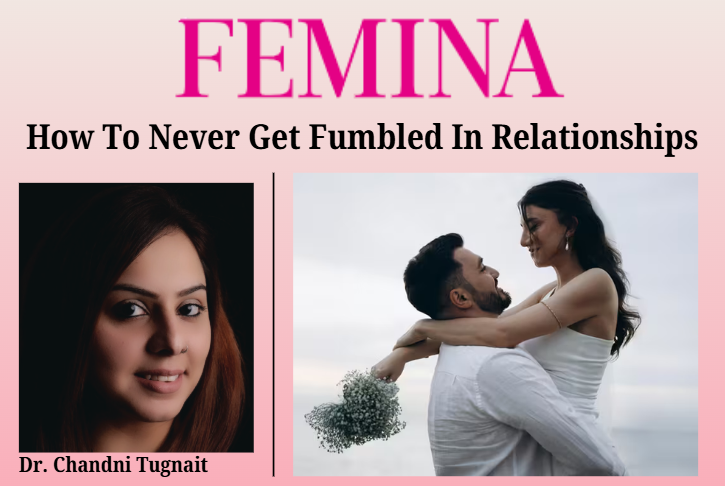
Never Get Fumbled
Parul Karn digs in with experts to understand why we get fumbled and how to stop it happening
It’s all over the internet. Baddies getting fumbled by someone so mid it almost feels offensive. But, before we go on, for those who don’t get the present-day usage of “fumbled”, in Gen Z slang, it is when someone messes up their chance with you. They know you’re a catch, they know the connection has potential, and yet they sabotage it due to inconsistency, fear, or sheer stupidity. They break your heart and lose you.
All because they mishandled something good. Not because you were not enough.
If you’ve never been fumbled, great for you. Still, it’s better to know how to avoid it than suffer through it. If you have been fumbled before, even low key, you must take charge to avoid getting fumbled again.


THERE WILL BE SIGNS
How do you recognise when you’re being fumbled versus when a connection is fading naturally? Gurgaon-based Dr Chandni Tugnait, MD (AM), psychotherapist, life alchemist, coach and healer, and founder and director – Gateway of Healing, says, “You’re being fumbled when someone’s words and effort don’t match.” They might express care and affection, but their consistency drops, plans start to feel vague, a communication gap develops, and you’re left more confused than ever.
“When a connection is naturally fading, however, both partners are aware of it, and their conversation still feels honest, even if difficult. A fumble feels like getting mixed signals, while a natural fade feels like having clarity and closure.”
Of course, it doesn’t happen out of the blue. If someone is about to fumble you, there will be signs. “Early signs include inconsistency, sudden gaps in communication, no clarity on future plans, and a lack of effort in everything,” Dr Chandni warns.
One of the most common reasons people get fumbled is that two individuals are quietly moving in different directions while pretending everything is fine. “One might want marriage soon, while the other sees it years later; one dreams of having children, the other avoids the conversation altogether,” says Ankita Kaul, a Mumbai-based counsellor, women’s positivity coach, and founder – Unfiltered Ladies and Miss Chulbulee. Instead of addressing these differences, couples often distract themselves with dinners, dates, and surface-level conversations.
IN SITUATIONSHIPS, FUMBLING OFTEN LOOKS LIKE AMBIGUITY, MIXED SIGNALS, AND INTENSITY WITHOUT COMMITMENT
The foundation of any lasting relationship is alignment. Alignment in timelines. Alignment in core values. Alignment in long-term vision. When those deeper conversations are avoided, misalignment grows silently. “The healthiest relationships are not built on chemistry alone,” Ankita points out. “They are built on mature discussions where both partners clearly express their needs, fears, expectations, and life goals. Fun is important, but so is clarity,” she adds.
You might feel you are chasing clarity, but pause instead of overcompensating. “Match their energy and ask directly where things stand,” Dr Chandni advises. “If answers remain unclear, believe the pattern. The right response lies in protecting your time and emotional investment.”
When clarity is missing, confusion takes over, and that is where people get fumbled. “Before marriage, for example, all you talk about is wedding dresses and venues,” Ankita reveals. “Who really talks about dynamics and expectations after marriage? Financial responsibilities? Division of work at home? These discussions are the core value system one puts in place before a relationship (or marriage) in order to walk with clarity and avoid fumbling.”


AT DIFFERENT STAGES
Fumbling shows up differently across situationships and exclusive relationships. In situationships, fumbling often looks like ambiguity, mixed signals, intensity without commitment, and deep conversations followed by distance. “You’re kept emotionally engaged but structurally undefined,” Dr Chandni explains.
“In exclusive relationships, it’s more subtle. Effort drops, emotional presence fades, accountability weakens, and you feel it but struggle to name it. The stage changes the form, but the feeling is similar. You start feeling less secure and more uncertain than before.”
SAY WHAT YOU NEED
If you can’t be authentic about who you are and what you want from a relationship, what’s the point anyway? “Expressing interest should not feel like a strategy,” Ankita avers. There’s nothing wrong with telling your partner you need more time together. There’s also nothing wrong with saying you need space.
“Healthy adults communicate boundaries without fear,” she agrees. “Relationships can’t sustain if they are inorganic; things should be able to flow and move smoothly.”
The fear of appearing “too needy” often comes from insecurity. It could be something caused by your past relationships, or just something you recognise as your pattern. “In a true partnership, expressing your emotional needs should not lead to judgement,” she explains. People have different capacities and expectations, and mature partners respond with understanding rather than reaction. Relationships are often overcomplicated when they are meant to be the safest space to express yourself honestly. Balance comes naturally when both individuals feel secure enough to speak openly.


KNOW YOUR ATTACHMENT STYLE
Attachment styles play a significant role in relationship dynamics. Many people unconsciously repeat patterns without realising it. “For instance, someone with an anxious attachment style might feel drawn to an avoidant partner,” Ankita shares. “Avoidant individuals might show strong interest initially, but, due to unresolved emotional wounds, they might later withdraw. The anxious partner, sensing the distance, might start chasing, overcompensating, or seeking reassurance. This shift intensifies the imbalance.”
Eventually, the avoidant partner might pull away completely, ghost the other, or end the relationship. “But is one person solely at fault? Not necessarily,” she says. Both partners are often operating from unexamined patterns. The real solution lies in self-awareness. When individuals understand their attachment style and actively work toward becoming more secure, they stop repeating painful cycles.
If someone truly wants to leave, no amount of control can make them stay. If someone genuinely wants to stay, they will choose to work through discomfort. Emotional security allows a person to attract healthier dynamics instead of chasing what feels familiar but unavailable.
THE ULTIMATE SHIELD
Self-worth is perhaps the most important factor in keeping a relationship healthy. “If someone already struggles with low self-esteem, being with a partner who undermines them only deepens that wound,” Ankita says. “But, when a person is grounded in who they are, they do not internalise mistreatment. They recognise it for what it is.”
Knowing your worth means understanding that love is not something you beg for. It is something you choose and you are chosen in return. When you value yourself, you walk away from situations that do not honour you. That level of awareness requires introspection, growth, and experience.
Every relationship will face challenges. “The difference lies in whether both individuals consciously choose respect, communication, and alignment. When you know you are valuable, you stop chasing validation and start choosing compatibility,” she concludes. And that shift alone makes it far less likely that you will ever get fumbled.
The articles, news features, interviews, quotes, and media content displayed on this page are the property of their respective publishers and media houses. All such materials have been sourced from publicly available online platforms where our name, views, or contributions have been referenced, quoted, or featured.
Gateway of Healing / Dr. Chandni Tugnait / Others (as applicable) does not claim ownership over any external media content reproduced or linked here. The purpose of displaying these articles is solely for informational use, record-keeping, and to acknowledge media mentions related to our work.
Full credit for authorship, editorial content, and intellectual property rights belongs to the original publishers, journalists, and media organizations.
If any publisher or rights holder wishes to request modification, updated attribution, or removal of any content featured on this website, they may contact us at info@gatewayofhealing.com, and we will take appropriate action promptly.
Read the Article on Author's webpage - CLICK HERE


