

Close Menu
    Facebook X (Twitter) Instagram
    Friday, October 16
    Facebook X (Twitter) LinkedIn VKontakte
    chandnitugnaitinnews
    Banner
    • Home
    • Media Presence
    • Mind & wellness
      • Cognitive Health
      • Mental Health
    • Family & Friends
      • Family
      • Friends
    • Relationship
      • Connection & Care
      • Love & Bonding
    • Well Being
      • Life
      • Positivity
    • Workplace
      • Career
      • Workplace
    • contact us
    chandnitugnaitinnews
    Home » From arranged to co-piloted: How Indian parents are joining their children’s search for love

    From arranged to co-piloted: How Indian parents are joining their children’s search for love

    Reproduced only for reference to articles mentioning our name. All rights remain with the original publisher.

    Indian matrimony is moving beyond the traditional arranged-versus-love marriage binary, as young adults and their parents increasingly become co-pilots in the search for a life partner.
    TheIndianExpressTheIndianExpress Love & Bonding September 16, 20265 Mins Read2 Views
    Share Facebook Twitter Pinterest LinkedIn Tumblr Email WhatsApp
    Share
    Facebook Twitter LinkedIn Pinterest Email
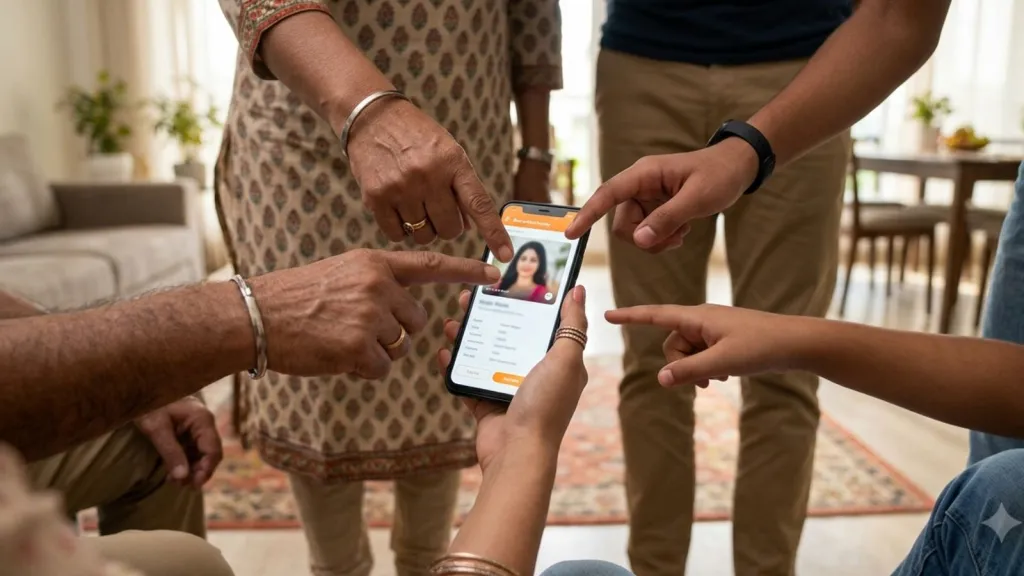
    For much of the past two decades, Indian marriage has been framed as a binary choice: either two people fell in love and built a life on their own terms, or their families found a match, and the couple built a life shaped by family expectations. But a growing number of Indian matrimony or dating apps now let parents and their children jointly manage a single account, swiping, chatting, and shortlisting matches together instead of one person handling it alone. But this shift works only because both sides are choosing to do it together. Parents aren’t forcing their way into the dating dynamic; the individual isn’t just tolerating it, but accepting it. Each side gets something out of the arrangement that solo dating didn’t give them.
    According to experts, parents becoming ‘co-pilots’ is a curious contradiction in modern relationships. “Today’s young adults might enjoy much greater freedom in selecting their partners, but many are still closely tied to their families, both emotionally and practically. So, while parents may not be literally at the wheel, they can still influence the way the relationship is driven.”

    The shift

    Anirban Banerjee, interim CEO, Flutrr says, “On major matrimonial platforms, the share of profiles created and managed by the individual themselves has climbed sharply over the past decade, while parent-managed profiles have fallen by a similar margin. This is not a small shift. It marks a change in who does the searching. At the same time, a majority of users, a large share of whom are women, still say that having their family involved makes the process feel less stressful, not more controlling.” That combination is easy to miss if the only lens available is ‘independent’ versus ‘arranged’. The numbers describe a process where the person leads the search, and the family supports the decision, rather than the other way around. This helps explain why the strict version of arranged marriage, where a child has little to no say, has been declining steadily. “Surveys tracking this over the past several years show that fully parent-directed matches have dropped meaningfully, while a hybrid model, often called joint arranged marriage, now accounts for the largest share of unions,” says Anirban. In this model, a person searches, filters, and has real conversations before presenting a match to the family for review rather than approval. The distinction matters because it changes what parents are actually doing. They are no longer the ones deciding who is right. They are doing due diligence on a decision already made emotionally.

    Why both generations are choosing to co-pilot

    Dr Chandni Tugnait, psychotherapist, Gateway of Healing says, “Co-piloting doesn’t mean young Indians have lost autonomy. It means both generations found a version of dating that shares the risk and the decision fatigue, instead of leaving either person to carry all of it alone” Here are a few reasons she suggests why both generations choose to co-pilot:
    • Apps built the role: Several matrimony platforms now offer joint-use features, letting parents view matches or messages alongside the person they’re helping, rather than acting entirely on their behalf. That structural shift made shared involvement easier and more natural for families who already leaned that way.
    • Swiping fatigue from dating apps: After months of matches that go nowhere, many young daters genuinely stop trusting their own judgment on apps, and start wanting someone else’s eyes on the decision. Handing a parent partial control isn’t defeat. For many, it’s a relief from decision fatigue that solo swiping never solved.
    • It buys safety and peace: For many women especially, family involvement upfront reduces the risk of an unsafe match and avoids a much harder conversation later, introducing a partner the family was never consulted on. Getting buy-in early is often easier than seeking approval after the fact.
    • Self-created still means supervised: Even when the individual creates their own profile, parents frequently stay closely involved anyway, reviewing conversations from just behind the screen. The appearance of independence often hides an arrangement both sides have quietly agreed to.
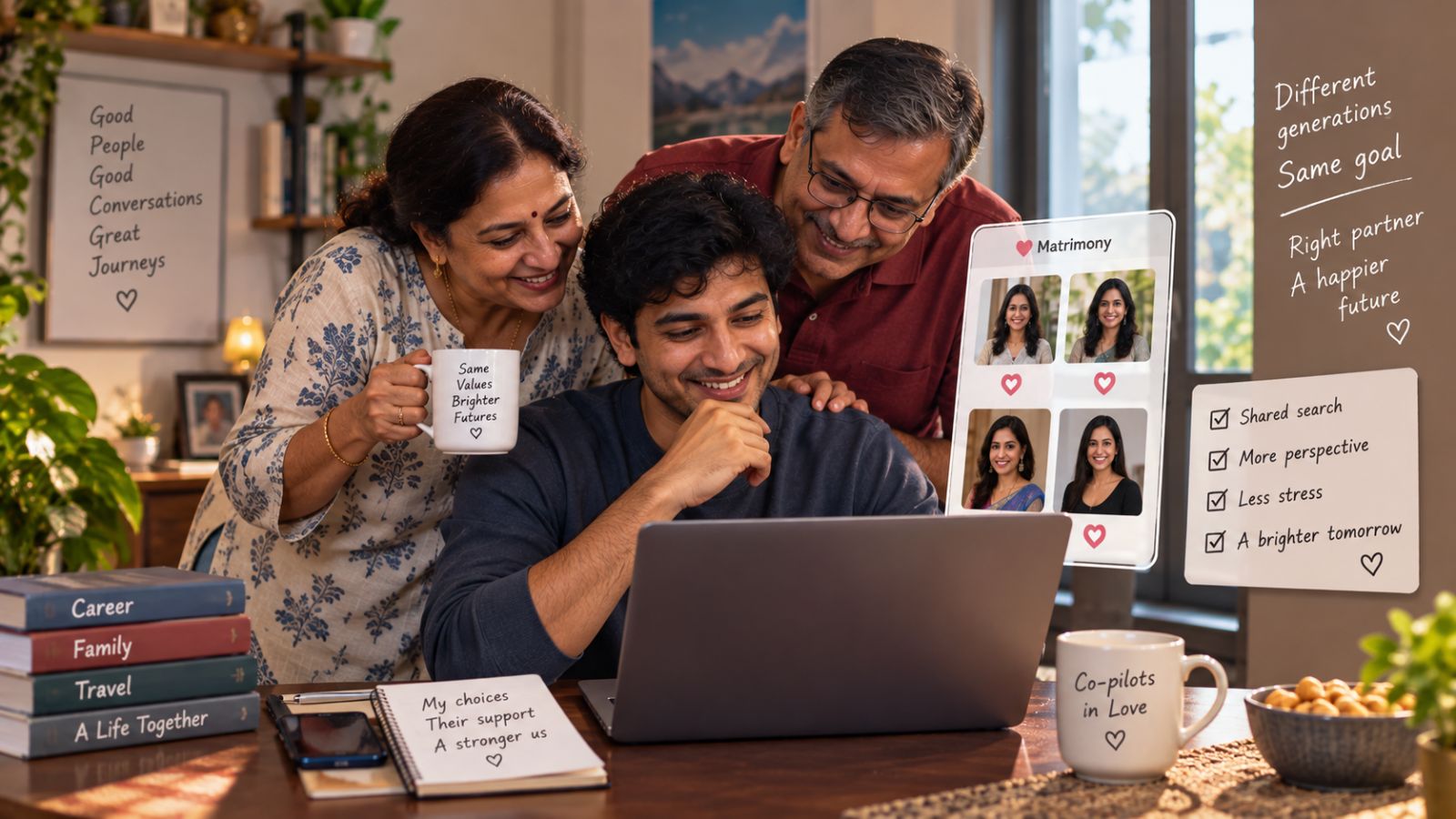
    Parents and their adult children are increasingly exploring matrimonial matches together, creating a new model of shared partner search Parents and their adult children are increasingly exploring matrimonial matches together, creating a new model of shared partner search (Image generated by AI)

    When it gets problematic

    Parents offer perspective, emotional support and practical help, especially at major life transitions. The trouble starts when help becomes interference in decisions which are really the couple’s own. Citing an example, Damini Grover, Counselling Psychologist, author and life coach, says, “If one partner immediately starts to discuss every disagreement in detail with their parents, the conflict is no longer between two people. The couple may work it out, but the parent can still carry resentment or judgment toward the partner. Similarly, if the couple is repeatedly asked to seek parental approval for money, living arrangements, holidays or parenting decisions, they may find it hard to develop their own identity as a unit.” It is also a key difference between seeking advice and outsourcing decisions. “Emotional adulthood doesn’t require that you cut your parents out of your relationship. This means being able to hear what they have to say without automatically allowing it to determine your choices,” says Damini. Experts say that a healthy relationship with parents requires both connection and boundaries. Parents can be helpful passengers on the trip, but if a couple always needs a third person to work out conflicts, make decisions, or validate choices, they might never learn to navigate the relationship on their own.

    The articles, news features, interviews, quotes, and media content displayed on this page are the property of their respective publishers and media houses. All such materials have been sourced from publicly available online platforms where our name, views, or contributions have been referenced, quoted, or featured.

    Gateway of Healing / Dr. Chandni Tugnait / Others (as applicable) does not claim ownership over any external media content reproduced or linked here. The purpose of displaying these articles is solely for informational use, record-keeping, and to acknowledge media mentions related to our work.

    Full credit for authorship, editorial content, and intellectual property rights belongs to the original publishers, journalists, and media organizations.

    If any publisher or rights holder wishes to request modification, updated attribution, or removal of any content featured on this website, they may contact us at info@gatewayofhealing.com, and we will take appropriate action promptly.

    Read the Article on Author's webpage - CLICK HERE

      Leave a comment

      Your email address will not be published. Required fields are marked *

      Family Involvement Family relationships Lifestyle wellbeing Marriage and Relationships Modern dating Relationship Compatibility Relationship Expectations Relationship psychology
      Share. Facebook Twitter Pinterest LinkedIn Tumblr Email
      Previous Articleक्या सोशल मीडिया बिगाड़ रहा है फोकस और मेंटल हेल्थ? जानें लगातार स्क्रॉलिंग के नुकसान

      Reproduced only for reference to articles mentioning our name. All rights remain with the original publisher.

      Next Article Why do we feel guilty for resting even when we’re exhausted? A psychotherapist explains the need to keep going

      Reproduced only for reference to articles mentioning our name. All rights remain with the original publisher.

      Related Posts

      Has Gen Z Stopped Raging at Nightclubs?

      Reproduced only for reference to articles mentioning our name. All rights remain with the original publisher.

      October 7, 2026

      Vijay Deverakonda says Rashmika Mandanna tells him ‘I love you’ 10-15 times a day: ‘More mature’

      Reproduced only for reference to articles mentioning our name. All rights remain with the original publisher.

      October 7, 2026

      एक सब शेयर करता है, दूसरा रहता है चुप; क्या यह आदत आपके रिश्ते में ला रही है दूरी?

      Reproduced only for reference to articles mentioning our name. All rights remain with the original publisher.

      October 7, 2026

      Comments are closed.

      Archives
      Recent Posts
      • From concert tickets to weekend getaways: Why young indians are spending more on experiences than things

        Reproduced only for reference to articles mentioning our name. All rights remain with the original publisher.

        October 12, 2026
      • Why do we feel awkward when someone compliments us? Psychotherapist explains why we struggle to accept praise

        Reproduced only for reference to articles mentioning our name. All rights remain with the original publisher.

        October 11, 2026
      • Workplace to brand culture: Can employees’ mental health become part of a company’s public identity?

        Reproduced only for reference to articles mentioning our name. All rights remain with the original publisher.

        October 11, 2026
      • How Beauty Advertising Influences Body Image: Dr Chandni Tugnait Explains Hidden Cost Of Chasing Perfection

        Reproduced only for reference to articles mentioning our name. All rights remain with the original publisher.

        October 11, 2026
      • Why has being busy become a status symbol? Psychotherapist explains our obsession with staying productive

        Reproduced only for reference to articles mentioning our name. All rights remain with the original publisher.

        October 10, 2026
      Dr. Chandni Tugnait is the founder of Gateway of Healing, a TEDx speaker, Relationship Expert – Tinder India, NeuroEnergetic Transformation Coach, Psychotherapist, Life Coach, Business Coach, NLP Expert, and Healer. Over the past 15 years, she has transformed lives of more than 50,000 individuals through her work. Featured in over 500 leading media publications, Dr. Chandni is recognized for her expertise in mental health, personal growth, and relationships. Her mission is to empower people to achieve success and well-being through the alignment of energy, mindset and action.
      About

      This website includes recreated content derived from Dr. Chandni’s media features. All original rights & credits belong to the respective publication or media house.

      Facebook X (Twitter) Instagram YouTube LinkedIn
      Copyright © 2026 . Designed by Redcube Digital Media Pvt. Ltd, . This website includes recreated content derived from Dr. Chandni’s media features. All original rights & credits belong to the respective publication or media house.

      Type above and press Enter to search. Press Esc to cancel.